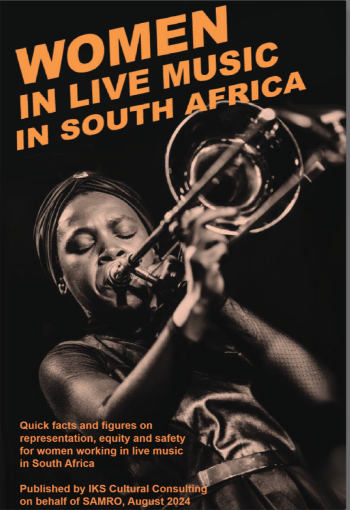
A photograph by Siphiwe Mhlambi of Siya Makuzeni features on the cover of Women in Live Music in South Africa downloadable from concertssa.co.za
“These graphics were inspired by ConcertsSA’s Andre le Roux. When we were drafting the text for SAMRO’s Women in Live Music report, he reflected how sad it was that so many of the stalwarts who’d asserted women’s place in live music were no longer with us to contribute.”
“So we thought: why not create a place for them – and through that, get readers interested in their stories and contribution? That was how the idea of women’s music history pages in the print publication began.”
“South Africa has produced so many powerful women musicians that any selection was bound to be arbitrary. In addition to well-known names (we couldn’t, for example, omit Mama Afrika!), we looked for a few whose profile was perhaps not so prominent. But then came the problem: how do we portray them in a way that integrates with the rest of the research report and bring a diverse collection of images together? So I asked Judy: What do you think? How can we do this?”
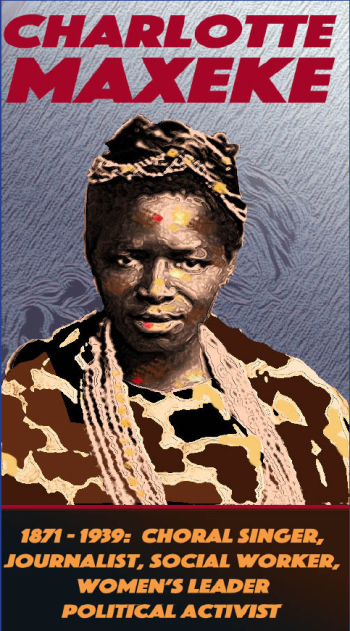
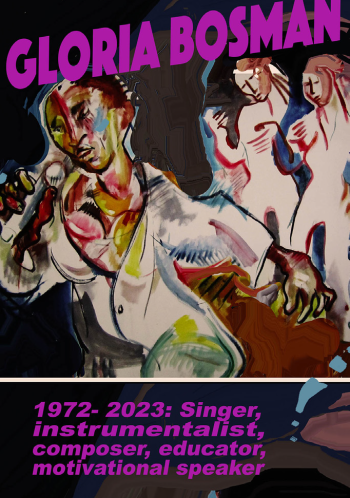
“I mostly had to base my work on photographs, although the portrait of Gloria Bosman is one I painted a long time ago, based on a club performance I attended. Some were old, some were of really variable quality; some – as in the case of Emily Motsieloa – are too well-known, because that is the only public image we have of her.”
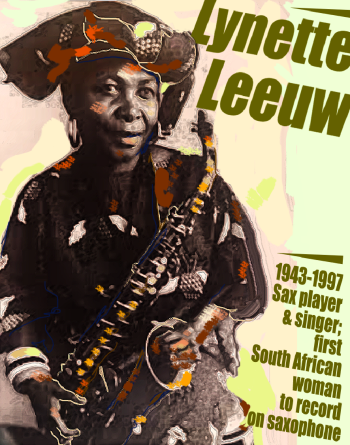
“So I thought: let me rather use the Photoshop paint process, but adapt it to the colour techniques I employ in my own paintings – for example, vibrant red highlights in unexpected places. I really don’t like the default oil-painting mode in Photoshop: it’s overly uniform. Even the ‘variations’ in brushstrokes are uniform. So while these graphics begin with the computer paint programme; in places I’ve worked over the that to fit with my personal brushstroke style, making my own choices about different types of texture and changes in contrast.”
“I must at this point offer a million thanks to artist Mzwandile Buthelezi, who, when he created a set of graphics for ConcertsSA some years back, granted the organisation permission to use, adapt and develop them as needed. That’s rare and important generosity. In the other pages of the research report I have stayed faithful to his colour palette – but in these graphic portraits I’ve done what I’ve been doing as a painter since university: consciously playing around with colours outside their shaded range.”
“I also wanted to get readers curious about the work these great women did, appreciating everything they gave to South African music. About a year ago, I was asked to write a journal article reflecting on how we portrayed people murdered by apartheid during the Struggle, in memorial posters and the like. It brought back memories of how, when we were doing that work – I was a member of the MEDU Graphics Unit in Botswana in the late 1970s & 1980s – we always spoke about the necessity not to dwell on death, but to celebrate the wonderful things those heroes did in their lives.”
“In the same way, with these portraits, I wanted to present these 11 women as icons – not in a cliched way, and not imprisoned by their gender or musical style: simply as creative humans doing amazing, important things. I aimed to make the portraits active: to create movement; to make sure the subjects were in performance, for example, or with their instruments.”
“I chose textures that conveyed movement, reflecting the internal rhythm of the images.”
“Over the years, I’ve tried very deliberately to draw and paint women musicians as musicians in their own right – the MEDU pianist Nellie Prins, for example, or Gloria Bosman, or Siya Makuzeni; what their music says to us about who they – and we – are, as women and as human beings. Creating these graphic portraits is a novel addition to a facts-and-figures research report; but for me, it is definitely part of that mission of reimaging women in live music.”